
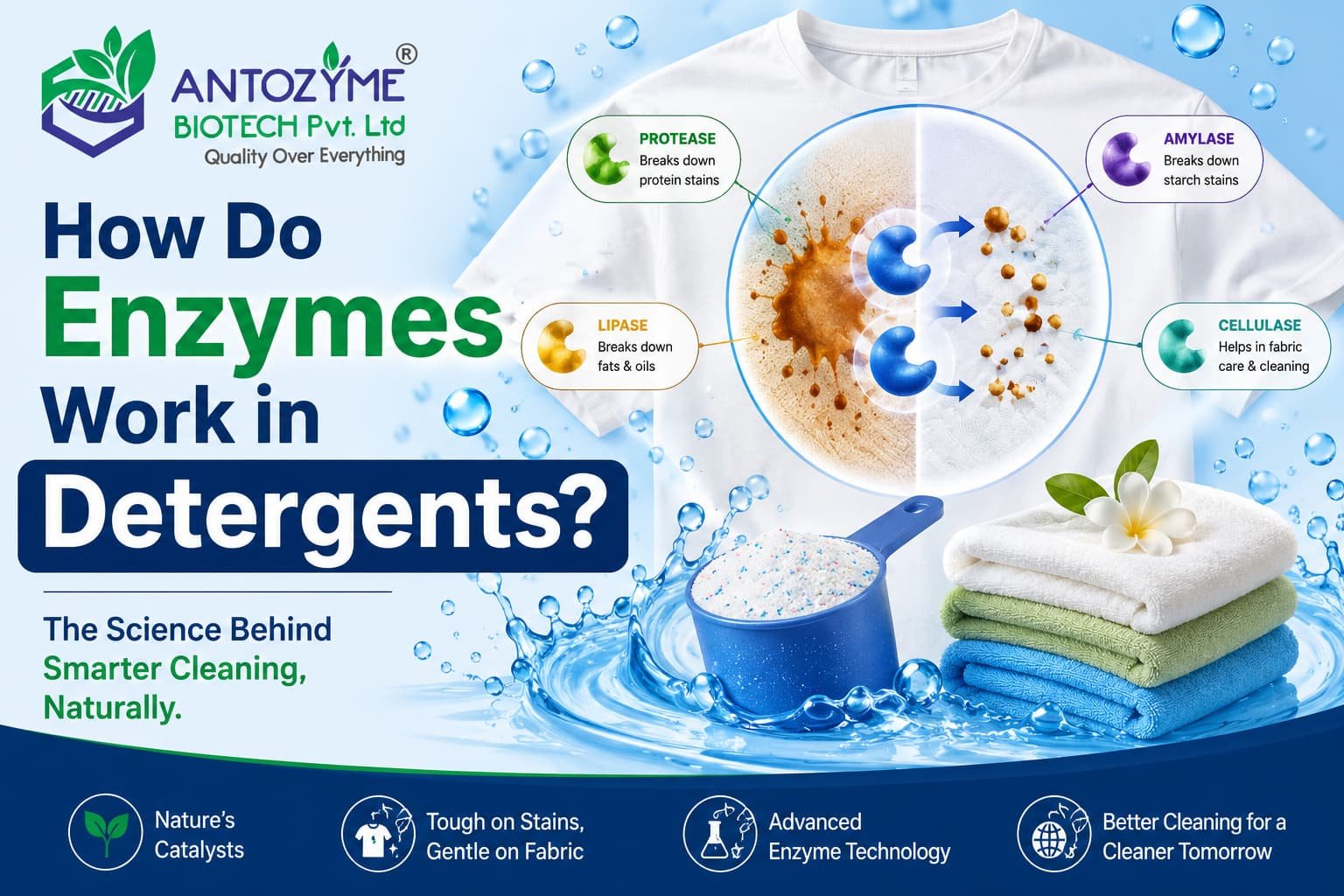
How do enzymes work in detergents? Enzymes work by breaking down specific components of stains, such as proteins, starches, fats, oils, and cellulose-based residues, into smaller molecules that can be more easily removed during washing. This targeted action makes enzymes valuable ingredients in modern laundry and cleaning formulations.
Unlike surfactants, which primarily help loosen, disperse, and suspend dirt, enzymes provide targeted biological action against particular types of organic stains. Protease works on protein-based stains, amylase targets starch, lipase helps break down fats and oils, and cellulase can support cellulose-related cleaning and fabric-care performance.
As detergent manufacturers increasingly explore effective and formulation-efficient cleaning technologies, enzyme based detergent in India, laundry detergent enzymes, and specialized detergent enzyme solutions have become important areas of interest.
This guide explains how detergent enzymes work, the different enzymes used in laundry products, how they interact with stains, and what manufacturers should consider when selecting enzymes for detergent formulations.
What Are Enzymes in Detergents?
Enzymes used in detergents are specialized proteins that accelerate specific chemical reactions involved in breaking down organic materials.
Many everyday stains are chemically complex. Protein, grease, starch, and food residues can adhere strongly to textile fibers, making them difficult to remove through water and surfactants alone.
Detergent enzymes help address this problem by targeting particular components of the stain.
For example:
- Protease breaks down proteins.
- Amylase breaks down starch.
- Lipase breaks down fats and oils.
- Cellulase acts on cellulose-based material.
- Mannanase can target certain mannan-containing food residues.
- Pectinase can act on pectin-containing plant residues.
Because different enzymes work on different substrates, detergent manufacturers may use individual enzymes or combinations of enzymes depending on the desired cleaning performance.
This is one reason detergent enzymes in India are increasingly relevant to manufacturers developing modern laundry and cleaning products.
How Do Enzymes Work in Detergents?
The easiest way to understand how do enzymes work in detergents is to think of enzymes as highly specific biological catalysts.
A stain may contain large molecules that are difficult to remove from fabric. An appropriate enzyme recognizes a particular component of that stain and accelerates its breakdown into smaller molecules.
For example, when protease encounters a protein-based stain, it breaks the protein structure into smaller peptides and other fragments. These smaller materials can then be more readily loosened, dispersed, and removed by the rest of the detergent system.
The process can broadly be understood as:
Complex stain → Enzyme action → Smaller molecules → Easier removal
The same principle applies to other enzymes.
Lipase acts on fats and oils, while amylase acts on starch. This targeted activity allows different enzymes to complement the cleaning action of surfactants and other detergent ingredients.
Why Are Enzymes Used in Laundry Detergents?
Enzymes are used in laundry detergents because they can target specific stain components that may otherwise be difficult to remove.
Everyday laundry can contain a mixture of:
- Food stains
- Protein residues
- Grease
- Cooking oils
- Sweat
- Body oils
- Starch
- Plant-based residues
A single cleaning ingredient may not effectively address all these materials.
Using suitable enzymes allows a detergent formulation to approach different stain types through different mechanisms.
This is why laundry detergent with enzymes in India is an important formulation concept for manufacturers seeking broader stain-removal performance.
Enzymes can also be selected for formulations intended to perform under particular temperature, pH, and washing-time conditions. However, actual performance always depends on the complete detergent formulation and washing environment.
What Types of Enzymes Are Used in Detergents?
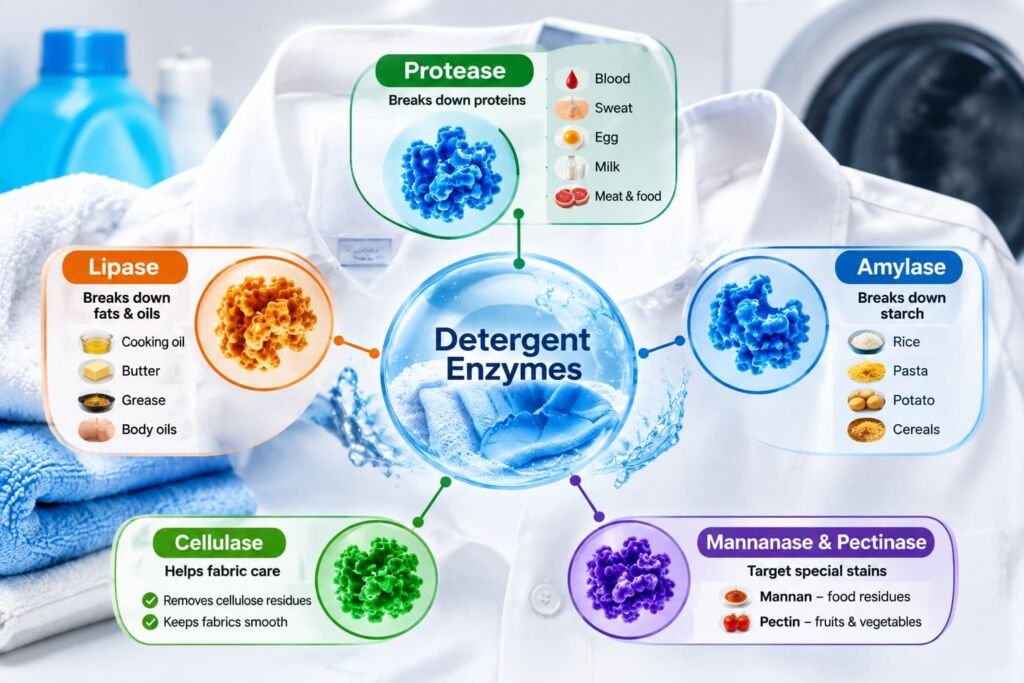
Different enzymes perform different functions in detergent formulations. The most common categories include protease, amylase, lipase, and cellulase, while specialized formulations may include additional enzyme activities.
Protease for Protein Stains
Protease is one of the most widely used enzymes in laundry detergent formulations.
It breaks down protein-based materials that can be found in stains such as:
- Blood
- Sweat
- Egg
- Milk and dairy residues
- Meat
- Food proteins
Protease hydrolyzes protein molecules into smaller fragments, helping the detergent system remove these residues more effectively.
Because protein stains are common in everyday laundry, protease laundry detergent in India is an important application area for enzyme technology.
Amylase for Starch Stains
Amylase targets starch-based residues.
Starch can be found in foods such as rice, pasta, potatoes, cereals, sauces, and other processed foods.
When amylase acts on starch, it breaks down the larger starch molecules into smaller components that can be more easily removed during washing.
Amylase is therefore commonly considered when developing detergent formulations intended to provide effective cleaning against food-related stains.
Lipase for Oil and Grease
Lipase works on fats and oils.
Typical oily stains can originate from:
- Cooking oil
- Butter
- Grease
- Fat-containing food
- Sebum
- Body oils
Lipase hydrolyzes triglycerides into smaller components, helping the overall detergent system deal with oily residues.
For manufacturers developing enzyme detergents in India, lipase can be particularly useful when oily and greasy stains are an important performance requirement.
Cellulase for Fabric Care
Cellulase acts on cellulose-based materials.
In laundry formulations, cellulase may contribute to the removal of certain cellulose-related residues and can also support fabric-care properties.
Depending on the enzyme type and formulation, cellulase may help reduce surface fuzz and maintain a smoother appearance of cotton and other cellulosic fabrics.
Its role is therefore somewhat different from protease, amylase, and lipase, which are primarily associated with specific stain categories.
Mannanase and Other Specialized Enzymes
Some detergent formulations use additional enzymes such as mannanase and pectinase.
Mannanase can target mannan-containing residues found in certain food products and sauces.
Pectinase can act on pectin-containing residues associated with fruits and vegetables.
These enzymes may be considered when a formulation requires additional stain-removal capabilities beyond the more commonly used protease, amylase, lipase, and cellulase.
How Do Enzymes and Surfactants Work Together?
Enzymes do not replace surfactants in a detergent.
Instead, they generally perform complementary functions.
Surfactants help loosen soil from textile fibers and keep removed soil dispersed in the wash water. Enzymes, meanwhile, target specific organic components within the stain.
For example, a greasy food stain may contain proteins, fats, and other food residues. Lipase can act on the oily component, while protease may act on protein components. Surfactants then help disperse the resulting materials and facilitate their removal.
This combination is an important reason detergent with enzymes in India can provide targeted cleaning performance when properly formulated.
The final result depends on how all components interact rather than on enzyme activity alone.
Why Are Multi-Enzyme Detergents Used?
Laundry stains are rarely made of only one type of material.
A single stain may contain proteins, carbohydrates, fats, pigments, and other substances simultaneously. This makes a multi-enzyme approach useful for some detergent formulations.
A multi-enzyme system may combine:
- Protease for proteins
- Amylase for starch
- Lipase for fats and oils
- Cellulase for cellulose-related applications
- Mannanase for specific food residues
The exact combination depends on the intended detergent, target stains, formulation chemistry, and desired performance.
For manufacturers, customized multi-enzyme blends can provide an opportunity to develop an enzyme system around specific application requirements rather than simply adding several enzymes independently.
This is particularly relevant to businesses exploring enzyme based detergents in India for different laundry and cleaning applications.
Can Enzymes Be Used in Liquid Detergents?
Yes, enzymes can be used in liquid detergent formulations.
However, liquid detergents can present different stability challenges compared with powder detergents. Enzyme activity may be affected by factors such as pH, surfactants, preservatives, water activity, storage temperature, and interactions with other formulation ingredients.
Therefore, enzymes for liquid detergent need to be selected with the complete formulation in mind.
Manufacturers may evaluate:
- Enzyme stability
- Activity retention
- Formulation pH
- Surfactant compatibility
- Storage stability
- Enzyme dosage
- Temperature performance
- Compatibility with other ingredients
A suitable enzyme preparation should maintain the required performance throughout the intended shelf life of the detergent.
What Factors Affect Detergent Enzyme Performance?
Enzyme performance is influenced by several formulation and washing conditions.
Temperature
Each enzyme has an appropriate temperature range for activity and stability.
Extremely high temperatures can reduce enzyme activity, while lower temperatures may slow enzymatic reactions.
pH
Different enzymes have different pH activity and stability profiles.
The enzyme therefore needs to be compatible with the pH of the detergent formulation and intended washing conditions.
Enzyme Dosage
Higher enzyme dosage does not necessarily mean proportionally better cleaning.
The appropriate dosage depends on enzyme activity, formulation composition, stain type, washing conditions, and the required performance level.
Washing Time
Enzymatic reactions require sufficient contact between the enzyme and its target substrate.
Washing time can therefore influence the overall contribution of enzymatic cleaning.
Formulation Compatibility
Surfactants, builders, polymers, preservatives, fragrances, and other ingredients can affect enzyme stability and activity.
This makes formulation testing important when selecting detergent enzyme in India for commercial products.
Water Conditions
Water hardness and other water characteristics can influence overall detergent performance and should be considered during product development.
Storage Conditions
Temperature and storage duration can affect enzyme stability, particularly in liquid detergent systems.
Are Enzyme-Based Detergents Better for Stain Removal?
Enzyme-based detergents can provide an advantage when the formulation needs to target specific organic stains.
However, it is not accurate to say that every enzyme detergent will automatically outperform every conventional detergent.
The final cleaning performance depends on:
- Enzyme selection
- Enzyme activity
- Dosage
- Detergent formulation
- Surfactant system
- Water conditions
- Washing temperature
- Washing time
- Type of stain
A properly designed enzyme system can complement the other ingredients and improve targeted stain removal.
For this reason, manufacturers should evaluate actual washing performance rather than selecting enzymes based only on technical specifications.
What Is a Bio Enzyme Detergent?
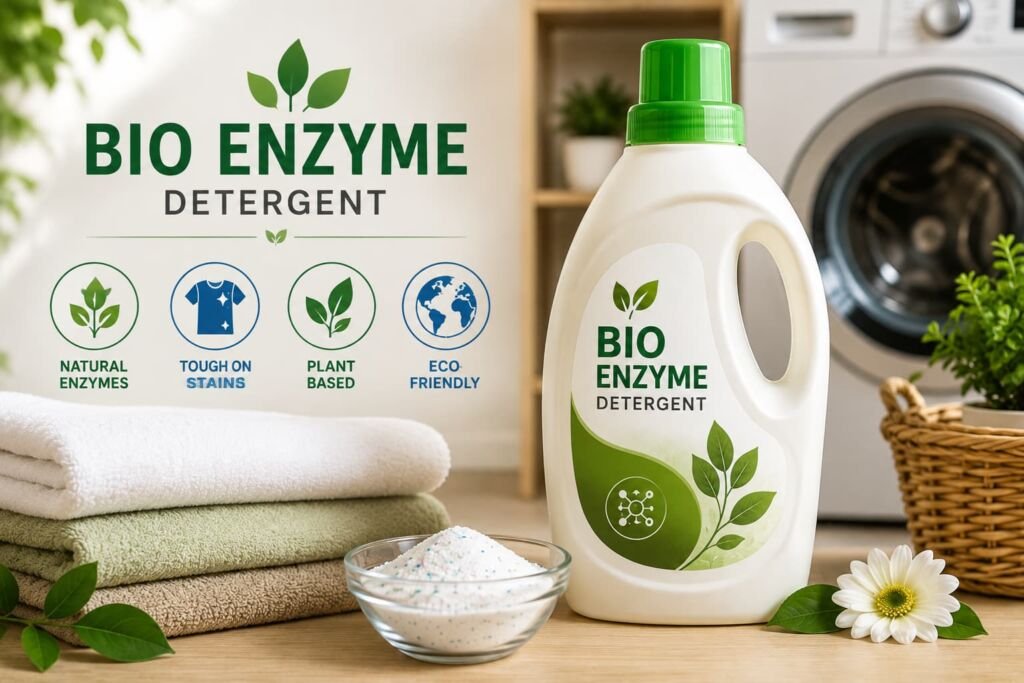
The term bio enzyme detergent is commonly used to describe cleaning products that incorporate enzymes or are marketed around biological cleaning technology.
However, terminology can vary between products and manufacturers.
An enzyme-based detergent specifically refers to a detergent containing enzymes that perform targeted biological activity against particular stain components.
When comparing products or raw materials, it is therefore better to examine the actual enzyme composition, activity, formulation, and application performance rather than relying only on terms such as “bio enzyme.”
How Are Detergent Enzymes Selected for a Formulation?
Selecting an enzyme requires more than identifying a stain and choosing a corresponding enzyme.
Manufacturers generally need to consider the complete application.
Important factors include:
- Target stain types
- Powder or liquid detergent format
- Formulation pH
- Washing temperature
- Required enzyme activity
- Enzyme dosage
- Storage stability
- Compatibility with surfactants and other ingredients
- Desired fabric-care properties
- Overall formulation performance
For example, a detergent designed primarily for protein-rich stains may place greater emphasis on protease, while a broad-spectrum laundry formulation may benefit from a combination of protease, amylase, lipase, and cellulase.
Application testing is particularly valuable because the same enzyme may perform differently depending on the surrounding detergent formulation.
What Should Manufacturers Consider When Choosing a Detergent Enzyme Supplier?
For businesses developing commercial detergents, selecting an appropriate enzyme supplier or manufacturer is an important part of formulation development.
The supplier should ideally provide more than a basic enzyme specification sheet.
Manufacturers may consider:
- Enzyme activity and consistency
- Batch-to-batch quality
- Formulation compatibility
- Stability information
- Technical documentation
- Application support
- Custom enzyme blends
- Packaging and storage guidance
- Supply capability
- Technical assistance
A specialized detergent enzyme manufacturer in India can help manufacturers evaluate enzyme options according to the intended detergent application.
For businesses looking for detergent enzyme manufacturers, technical understanding of laundry formulations can be just as important as product availability.
Detergent Enzymes in India: What Manufacturers Need to Know
The Indian detergent market includes powder detergents, liquid detergents, concentrated formulations, and specialized cleaning products.
As manufacturers develop products for different consumer and industrial requirements, enzyme technology can help address specific cleaning challenges.
Businesses searching for enzyme detergent in India, enzyme based detergent in India, or detergent enzymes in India should evaluate enzyme solutions according to their actual formulation requirements.
For example, a manufacturer may require:
- Protease for protein stains
- Amylase for starch-based stains
- Lipase for oily residues
- Cellulase for fabric-care applications
- Specialized enzymes for particular food stains
- Multi-enzyme blends for broader cleaning performance
The right enzyme solution depends on the intended product, formulation conditions, dosage, and performance requirements.
For this reason, choosing an experienced detergent enzyme manufacturer in India can be useful when moving from laboratory formulation to commercial production.
Where Are Enzymes Used in the Detergent Industry?
Enzymes are used across different areas of the cleaning industry.
Applications can include:
- Household laundry detergents
- Liquid laundry detergents
- Powder laundry detergents
- Institutional laundry products
- Commercial cleaning formulations
- Dishwashing formulations
- Specialized stain-removal products
The specific enzyme combination varies according to the application.
This broader use of enzymes in detergent industry applications reflects the ability of enzyme technology to provide targeted action against different organic materials.
How Can Manufacturers Improve Detergent Performance With Enzymes?
The most effective approach is not simply to increase enzyme concentration.
Instead, manufacturers should first identify the major cleaning challenges and then develop the enzyme system around those requirements.
A practical development process can include:
Identify the stain → Select appropriate enzyme activity → Evaluate formulation compatibility → Optimize dosage → Conduct washing tests → Assess stability → Finalize formulation
This approach can help determine whether an individual enzyme or a multi-enzyme system is more appropriate.
It also reduces the risk of selecting an enzyme based solely on laboratory activity without understanding its performance in the final detergent.
Why Customized Enzyme Blends Can Be Useful
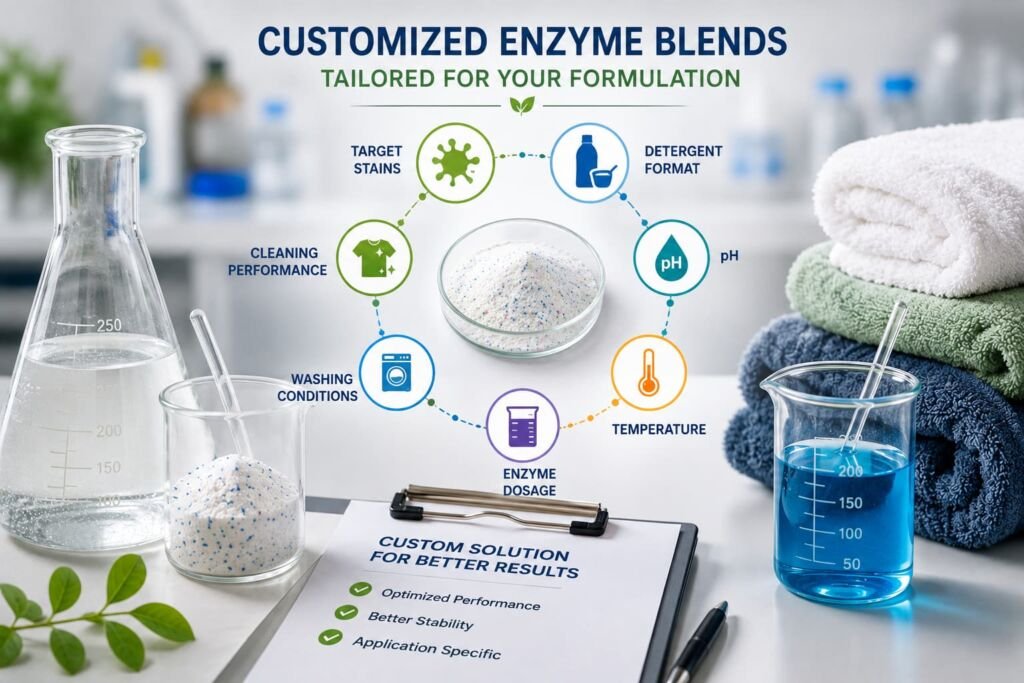
Different detergent products have different requirements.
A manufacturer producing a liquid detergent may have different enzyme stability requirements from a powder detergent manufacturer. Similarly, a product designed for heavily soiled workwear may require a different enzyme profile from a general household laundry detergent.
Customized enzyme blends can be developed around factors such as:
- Target stains
- Detergent format
- pH
- Temperature
- Enzyme dosage
- Washing conditions
- Required cleaning performance
This makes customized enzyme solutions particularly relevant for manufacturers looking beyond standard off-the-shelf enzyme preparations.
Businesses evaluating enzyme detergents in India can therefore benefit from discussing their specific application requirements with an enzyme supplier before finalizing the formulation.
Choosing an Enzyme Supplier or Manufacturer in India
When sourcing detergent enzymes, manufacturers should look beyond the basic question of price.
A reliable supplier should be able to provide consistent enzyme quality and relevant technical information while supporting the application requirements of the detergent manufacturer.
Factors worth evaluating include enzyme activity, stability, technical documentation, supply consistency, formulation compatibility, and the ability to provide customized solutions.
For manufacturers developing enzymes laundry detergent in India, technical consultation can help identify whether an individual enzyme, combination of enzymes, or customized blend is appropriate.
Antozyme Biotech works with enzyme applications for detergent and cleaning formulations, including individual detergent enzymes and customized multi-enzyme solutions. For formulation-specific requirements, manufacturers can discuss their target stains, detergent format, pH, temperature, and desired performance to identify a suitable enzyme approach.
Looking for the right enzyme system for your detergent formulation? Sharing your detergent type and formulation requirements with an experienced enzyme supplier can be a practical first step toward identifying suitable enzyme activities and testing the right solution.
Conclusion
So, how do enzymes work in detergents? They accelerate the breakdown of specific organic components of stains into smaller molecules that can be more easily removed during washing.
Protease targets proteins, amylase works on starch, lipase breaks down fats and oils, and cellulase can support cellulose-related cleaning and fabric-care applications. Additional enzymes such as mannanase and pectinase can be considered for specific stain challenges.
The effectiveness of an enzyme detergent depends on much more than the presence of enzymes. Enzyme selection, activity, dosage, pH, temperature, washing time, formulation compatibility, and storage stability all influence the final result.
For consumers, this explains why detergents with enzymes in India can provide targeted cleaning against difficult organic stains. For detergent manufacturers, it highlights why choosing the appropriate enzyme system is an important part of product development.
Whether the requirement is for enzymes for liquid detergent, protease, lipase, amylase, cellulase, or a customized multi-enzyme blend, application-specific evaluation can help determine the most suitable solution.
Frequently Asked Questions
How do enzymes work in detergents?
Enzymes work by breaking down specific components of stains into smaller molecules that are easier for the detergent system to remove. Different enzymes target different materials, such as proteins, starches, fats, and cellulose.
What enzymes are commonly used in laundry detergents?
The most commonly used detergent enzymes include protease, amylase, lipase, and cellulase. Some formulations may also use mannanase, pectinase, or other specialized enzymes depending on the target stains.
What does protease do in laundry detergent?
Protease breaks down protein-based stains such as blood, sweat, egg, dairy, and other food proteins. It is widely used in laundry formulations because protein residues are common in everyday stains.
Can enzymes be used in liquid detergents?
Yes. Enzymes can be incorporated into liquid detergents, but their stability must be considered carefully. Formulation pH, surfactants, preservatives, storage temperature, and other ingredients can affect enzyme stability.
Are enzyme-based detergents effective for removing stains?
Enzyme-based detergents can provide targeted cleaning against organic stains. Their effectiveness depends on the enzyme type, activity, dosage, detergent formulation, stain composition, washing temperature, and washing time.
What is the difference between a single enzyme and a multi-enzyme detergent?
A single enzyme targets a particular type of stain component, such as protein or fat. A multi-enzyme detergent combines different enzyme activities to address multiple types of stains within the same formulation.
How do I choose a detergent enzyme supplier in India?
Manufacturers should consider enzyme activity, consistency, stability, formulation compatibility, technical documentation, supply capability, and application support. For specialized formulations, the ability to develop customized enzyme blends can also be important.
Can a detergent enzyme manufacturer provide customized enzyme blends?
Yes. Depending on the application and supplier capabilities, customized multi-enzyme blends can be developed according to factors such as target stains, detergent format, pH, temperature, dosage, and required cleaning performance.
