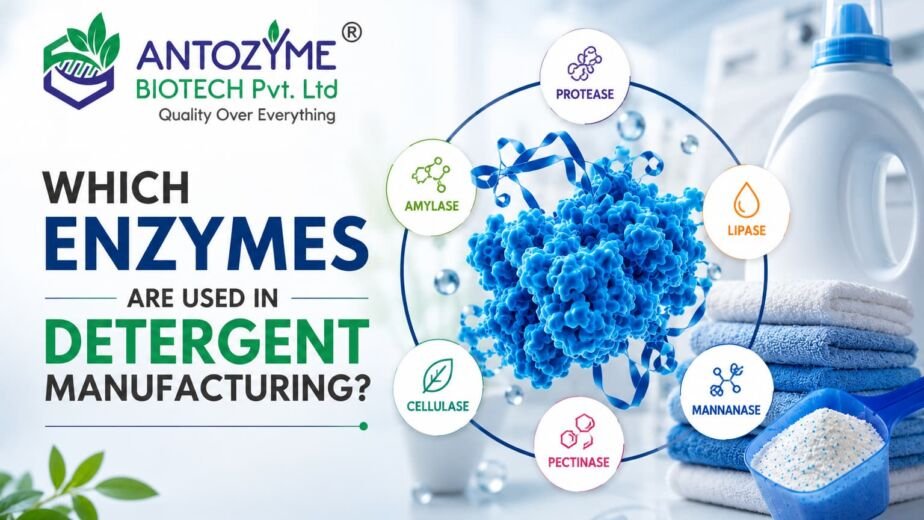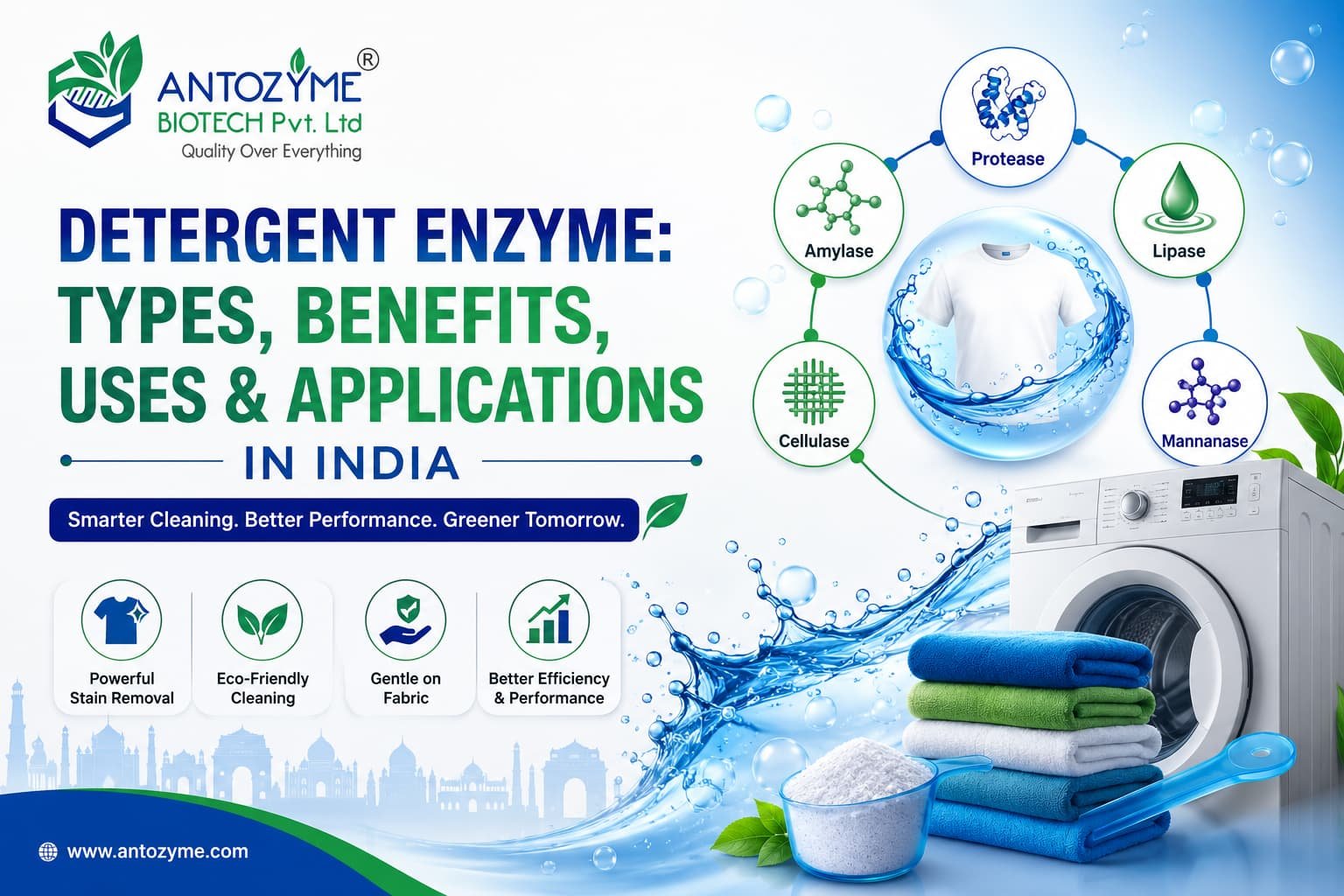
Detergent enzymes are specialized biological ingredients used to improve the cleaning performance of laundry and cleaning formulations. For manufacturers looking for a reliable detergent enzyme manufacturer in India, understanding enzyme types, benefits, uses, and applications is important for developing effective detergent products.
Detergent enzymes work by breaking down specific components of stains into smaller substances that can be removed more easily during washing. Enzyme action in detergents can vary depending on the enzyme type, stain composition, washing temperature, pH, dosage, and overall detergent formulation.
For detergent manufacturers, selecting the right enzyme system depends on factors such as detergent format, target stains, washing conditions, formulation compatibility, storage stability, and the desired cleaning performance.
What Are Detergent Enzymes?
Detergent enzymes are specialized proteins that accelerate the breakdown of specific organic substances found in stains. They are incorporated into detergent formulations to support cleaning performance against protein-, starch-, fat-, oil-, and other organic-based soils.
Different enzymes perform different functions. For example, protease is used for protein-based stains, amylase targets starch, and lipase works on fats and oils. This targeted activity makes enzymes useful ingredients in modern laundry detergent formulations.
The effectiveness of an enzyme depends on the interaction between the enzyme and the detergent formulation. Factors such as pH, temperature, enzyme concentration, washing time, and the presence of other ingredients can influence performance.
Why Are Detergent Enzymes Important?
Modern detergents are expected to remove difficult stains while maintaining good fabric-care properties and providing consistent cleaning performance.
Enzymes help address this requirement by targeting specific components of stains. Instead of relying only on surfactants and other cleaning ingredients, detergent formulations can use enzymes to break down particular soils and make them easier to remove.
This is particularly useful when developing detergents intended to perform against mixed stains, where proteins, carbohydrates, fats, and other substances may be present together.
Types of Detergent Enzymes
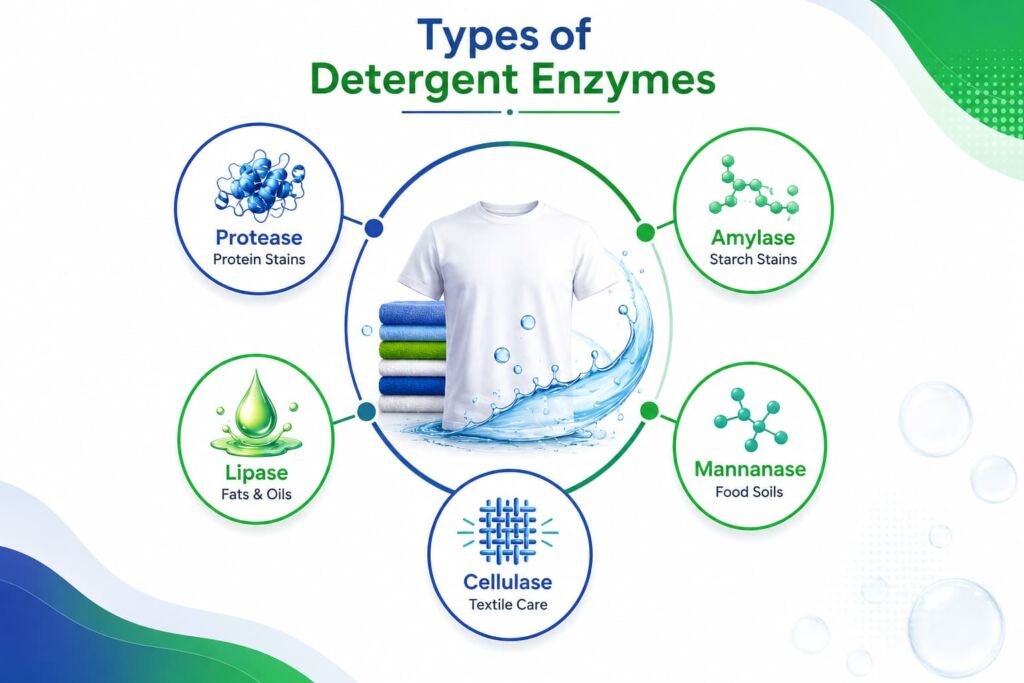
Different types of enzymes are used in detergent formulations based on the type of stain or cleaning requirement. The most common detergent enzymes include protease, amylase, lipase, cellulase, and mannanase.
1. Protease
Protease enzymes break down proteins into smaller peptides and amino acids. They are widely used in laundry detergent formulations because protein-based stains can become difficult to remove once they dry or become embedded in textile fibers.
Protease can help target stains such as:
- Blood
- Egg
- Milk
- Sweat
- Meat
- Protein-rich food residues
The selection of protease should take into account the formulation pH, washing temperature, enzyme activity, and compatibility with other detergent ingredients.
2. Amylase
Amylase is an enzyme that breaks down starch-based substances into smaller compounds. It can improve the removal of food-related stains containing starch.
Common target stains include:
- Rice
- Potato
- Pasta
- Flour
- Gravy
- Starch-containing foods
Amylase can be particularly useful in laundry formulations where food stains are an important cleaning challenge.
3. Lipase
Lipase enzymes help break down fats and oils. They are therefore useful in detergent formulations designed to target greasy and oily soils.
Lipase may help address:
- Cooking oil
- Grease
- Butter
- Fat
- Oily food residues
- Sebum
The performance of lipase depends on factors such as enzyme activity, formulation conditions, temperature, and the nature of the oily soil.
4. Cellulase
Cellulase acts on cellulose-based textile fibers and can provide fabric-care benefits in appropriately formulated laundry detergents.
Depending on the formulation and textile type, cellulase can help with:
- Reducing surface fuzz
- Improving fabric appearance
- Supporting color maintenance
- Removing certain particulate soils
- Maintaining a smoother fabric surface
Cellulase needs to be carefully selected and dosed according to the intended textile application.
5. Mannanase
Mannanase targets mannan-based compounds that can occur in certain food ingredients and processed foods.
It may be useful against stains associated with:
- Sauces
- Ice cream
- Processed foods
- Certain plant-based food products
Mannanase can be incorporated into specialized multi-enzyme detergent systems when the target stain profile requires this activity.
Benefits of Detergent Enzymes
The use of detergent enzymes can provide several benefits to modern detergent formulations.
Improved Stain Removal
Different enzymes target different stain components. Selecting the appropriate enzyme can improve the detergent’s ability to address difficult protein, starch, fat, oil, and other organic stains.
A properly designed enzyme system can complement surfactants and other detergent ingredients to provide more targeted cleaning performance.
Cleaning Performance at Suitable Temperatures
Some enzyme systems can perform effectively at lower or moderate washing temperatures when they are appropriately selected and formulated.
This can be useful for detergent products designed around different washing practices and temperature conditions.
Targeted Cleaning
One of the key advantages of enzymes is their substrate-specific activity. Protease, amylase, lipase, and other enzymes each target particular types of soils.
This allows detergent manufacturers to select enzyme systems according to the cleaning requirements of their products.
Support for Fabric Care
Certain enzymes, particularly cellulase, can provide fabric-care benefits in suitable formulations. These benefits may include improved fabric appearance and reduced surface fuzz after repeated washing.
Formulation Flexibility
Detergent enzymes can be used in various detergent formats, including powder detergents, liquid detergents, gels, and specialized cleaning formulations.
However, each format creates different requirements for enzyme stability, processing, storage, and compatibility.
Support for Formulation Optimization
Enzymes can complement other detergent ingredients rather than functioning independently. By combining enzymes with surfactants, builders, and other formulation components, manufacturers can optimize the overall cleaning system according to the intended application.
Uses of Detergent Enzymes
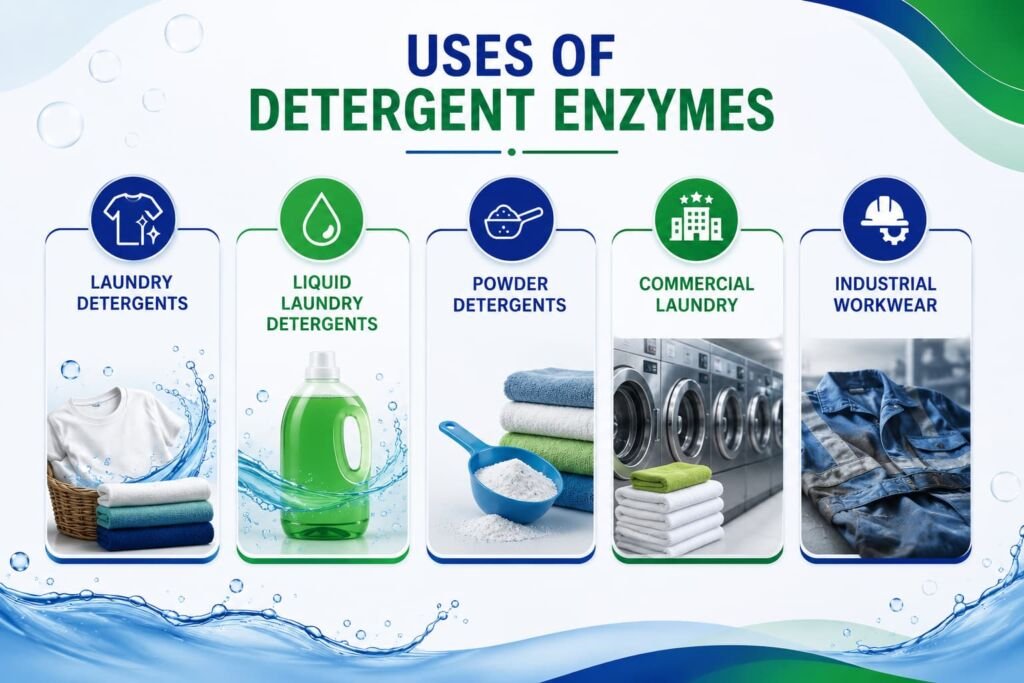
Detergent enzymes are used across household, commercial, institutional, and industrial cleaning applications.
Laundry Detergents
Laundry detergents are one of the most common applications for enzyme technology. Enzyme systems can help target everyday stains such as food residues, protein stains, oils, and starch-based soils.
A combination of enzymes can provide broader cleaning coverage when a detergent is expected to handle different types of stains.
Liquid Laundry Detergents
Liquid detergents require enzyme systems that remain stable within the formulation during storage and use.
Factors such as water content, pH, surfactants, preservatives, temperature, and storage time can influence enzyme stability. Therefore, enzyme selection should be carried out according to the complete liquid detergent formulation.
Powder Detergents
Powder detergents can incorporate enzyme systems designed for dry storage and release during the washing process.
Manufacturing conditions, moisture exposure, enzyme activity, and storage stability should be considered when selecting enzymes for powder formulations.
Commercial Laundry
Hotels, laundries, hospitals, restaurants, and other commercial operations can generate textiles with complex mixtures of organic, protein, oily, and food-based soils.
Multi-enzyme detergent formulations can be designed to address these different soil types according to the requirements of the application.
Industrial Workwear
Industrial workwear may accumulate grease, oils, food residues, proteins, and other difficult soils.
Detergent formulations containing appropriate enzyme systems can be considered for applications where targeted cleaning of organic soils is required.
Applications of Detergent Enzymes in India
The Indian detergent market includes household laundry products, commercial laundries, hospitality, healthcare, food-service operations, and industrial cleaning applications.
The requirements of manufacturers can differ depending on detergent format, consumer segment, washing practices, target soils, and operating conditions.
Household Laundry Products
Enzymes can be incorporated into household laundry detergents to help address common stains caused by food, proteins, starches, fats, and oils.
Manufacturers can select enzyme combinations according to the types of stains their target consumers commonly encounter.
Hospitality Laundry
Hotels and hospitality businesses regularly wash bed linen, towels, uniforms, and other textiles.
These materials may contain body soils, food residues, oils, and other organic contaminants. Appropriate enzyme systems can support the cleaning performance of commercial laundry formulations.
Healthcare Laundry
Healthcare laundry involves textiles that can contain various biological and organic soils.
Enzymes may be used as one component of a carefully designed detergent system, depending on the specific application, formulation requirements, and applicable cleaning protocols.
Food-Service and Restaurant Textiles
Restaurant uniforms, kitchen towels, napkins, and other food-service textiles can be exposed to oils, fats, sauces, proteins, and starches.
A multi-enzyme approach can be considered when a formulation needs to target several different types of food-related soils.
Industrial Workwear
Industrial uniforms and workwear can be exposed to oils, grease, food residues, and other organic contaminants.
Enzyme-containing detergent formulations may be developed according to the specific soil profile and cleaning conditions associated with the application.
How to Select the Right Detergent Enzyme
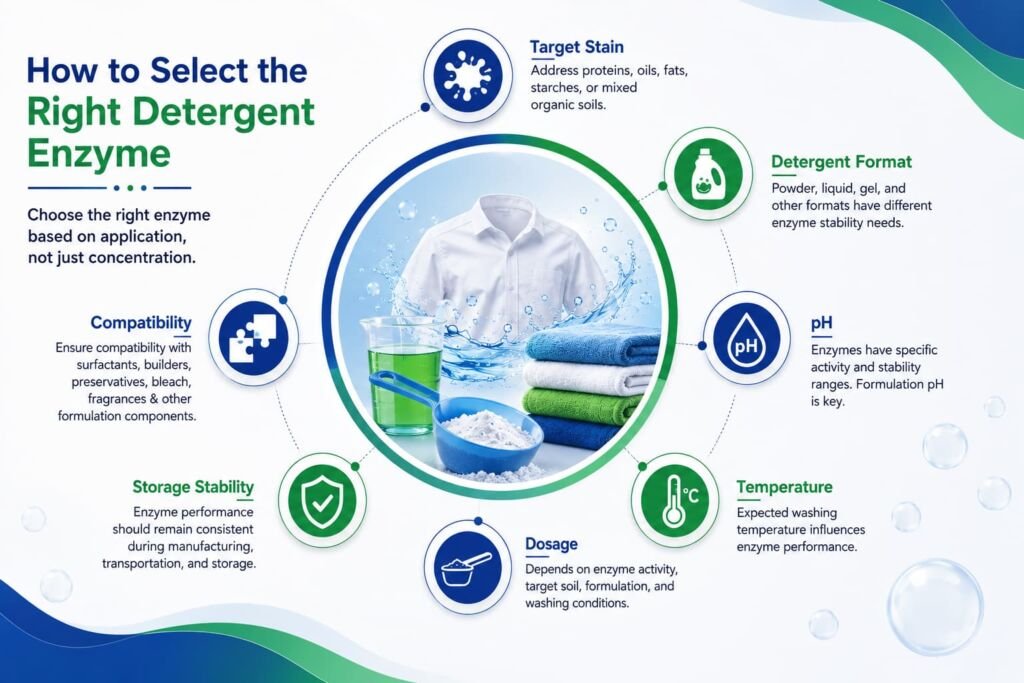
Choosing a detergent enzyme should begin with the intended application and target stain profile rather than simply selecting an enzyme based on concentration.
Important factors include:
Target stain: Determine whether the formulation needs to address proteins, oils, fats, starches, or mixed organic soils.
Detergent format: Powder, liquid, gel, and other formats have different enzyme stability requirements.
pH: Enzymes have specific activity and stability ranges, so formulation pH is an important consideration.
Temperature: The expected washing temperature can influence enzyme performance.
Dosage: The required dosage depends on enzyme activity, target soil, formulation, and washing conditions.
Storage stability: Enzyme performance should remain consistent throughout manufacturing, transportation, and storage.
Compatibility: Enzymes should be evaluated for compatibility with surfactants, builders, preservatives, bleaching systems, fragrances, and other relevant formulation components.
Why Multi-Enzyme Blends Are Used
Real-world stains often contain more than one type of substance. For example, a food stain may contain proteins, fats, carbohydrates, and other components.
This is one reason detergent manufacturers use multi-enzyme blends. Combining different enzyme activities can provide broader cleaning coverage than using a single enzyme.
A multi-enzyme detergent system may include:
- Protease for protein-based stains
- Amylase for starch-based stains
- Lipase for fats and oils
- Cellulase for selected textile-care applications
- Mannanase for specific food-related soils
The exact combination should be selected according to the detergent formulation, target stains, washing conditions, and desired performance.
Customized Detergent Enzyme Solutions
Different detergent products have different technical requirements. A detergent designed for household laundry may require a different enzyme system from a commercial laundry product or industrial workwear detergent.
Customized enzyme solutions can be developed around factors such as:
- Target stains
- Detergent format
- Formulation pH
- Washing temperature
- Enzyme dosage
- Required activity
- Storage conditions
- Processing conditions
- Compatibility with other ingredients
- Intended application
Working with an experienced detergent enzyme manufacturer in India can help detergent producers evaluate suitable enzyme options according to their specific formulation and performance requirements.
Detergent Enzyme Manufacturer in India
When choosing a detergent enzyme manufacturer in India, detergent producers should consider more than product pricing. Consistent enzyme activity, product quality, technical support, customization capability, supply reliability, and application expertise are all important factors.
A manufacturer and supplier with experience in enzyme solutions can help businesses evaluate suitable products based on their detergent format, target stains, formulation conditions, and required cleaning performance.
Antozyme Biotech manufactures and supplies enzyme solutions in India for industrial applications, including detergent formulations. Its enzyme solutions can support manufacturers looking for suitable ingredients for different detergent applications and formulation requirements.
For businesses developing or improving detergent products, discussing the specific formulation and conducting application testing can help identify the most suitable enzyme or multi-enzyme system.
Factors to Consider When Choosing a Detergent Enzyme Supplier
Before selecting an enzyme supplier, detergent manufacturers should evaluate the following factors:
Manufacturing Capability
Check whether the supplier has appropriate enzyme manufacturing capabilities and quality-control processes.
Product Consistency
Consistent enzyme activity is important for maintaining reliable detergent performance from batch to batch.
Technical Support
Technical assistance can be valuable when introducing enzymes into a new formulation or optimizing an existing detergent product.
Customization Capability
Different detergent applications may require different enzyme combinations, activity levels, or formulation approaches.
Supply Reliability
A dependable supply chain is important for manufacturers that require continuous production.
Application Expertise
A supplier with knowledge of detergent applications can better understand formulation challenges and help identify appropriate enzyme solutions.
Quality Documentation
Technical specifications, product information, and relevant quality documentation should be available for commercial formulation and procurement requirements.
Future Scope of Detergent Enzymes in India
The detergent industry continues to develop as manufacturers focus on cleaning efficiency, formulation optimization, product differentiation, and changing consumer expectations.
Enzyme technology can support these developments by providing targeted cleaning activities for different types of stains and applications.
The growing diversity of detergent products—from household laundry detergents to specialized commercial and industrial formulations—also creates opportunities for customized enzyme systems.
As manufacturers continue to develop application-specific detergents, enzyme selection, formulation compatibility, and multi-enzyme technology are likely to remain important areas of product development.
Conclusion
Detergent enzymes are important functional ingredients that help target different types of stains and support the cleaning performance of modern detergent formulations. Protease, amylase, lipase, cellulase, and mannanase each provide different activities, while multi-enzyme systems can provide broader coverage against mixed soils.
For detergent manufacturers in India, selecting the right enzyme requires consideration of the detergent format, target stains, pH, washing temperature, dosage, storage stability, and compatibility with other ingredients.
Choosing a reliable detergent enzyme manufacturer in India can help manufacturers evaluate suitable enzyme solutions and develop formulations according to their specific application requirements.
Antozyme Biotech manufactures and supplies enzyme solutions in India, supporting detergent manufacturers and other industrial users with enzyme ingredients and customized approaches for different applications.
Frequently Asked Questions
What are detergent enzymes?
Detergent enzymes are specialized proteins added to detergent formulations to break down specific organic components of stains, making them easier to remove during washing.
Which enzymes are commonly used in detergents?
Common detergent enzymes include protease, amylase, lipase, cellulase, and mannanase. The appropriate enzyme depends on the target stains and detergent formulation.
What does protease do in detergent?
Protease breaks down protein-based stains such as blood, milk, egg, and sweat into smaller components that can be removed more easily during washing.
What is the function of lipase in detergent?
Lipase helps break down fats and oils, making it useful for detergent formulations designed to target greasy and oily stains.
Why are multiple enzymes used in detergents?
Different stains contain different substances. Multi-enzyme formulations combine enzymes with different activities to provide broader coverage against protein, starch, oil, and other organic soils.
How do I choose a detergent enzyme manufacturer in India?
Consider manufacturing capability, product consistency, enzyme activity, technical support, customization options, supply reliability, quality documentation, and experience with detergent applications.
Can detergent enzymes be customized for different formulations?
Yes. Enzyme solutions can be selected or customized according to factors such as detergent format, pH, washing temperature, target stains, dosage, storage conditions, and compatibility with other ingredients.