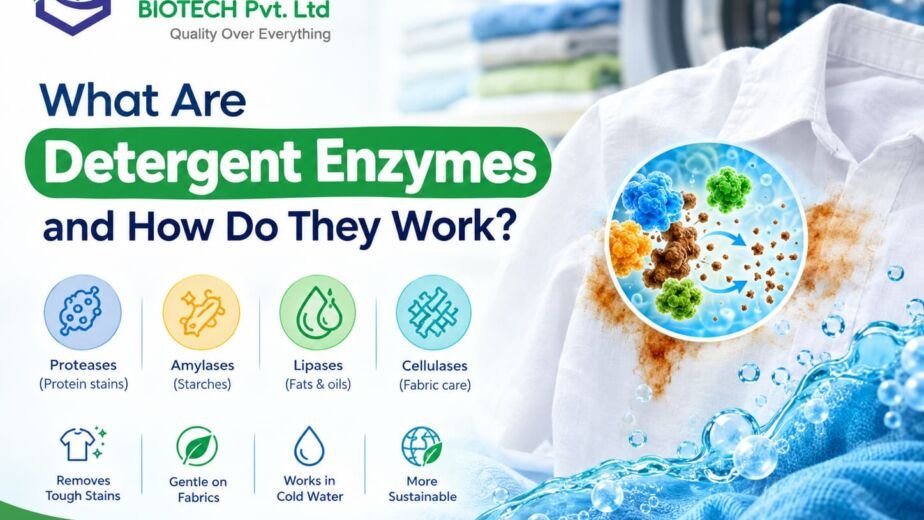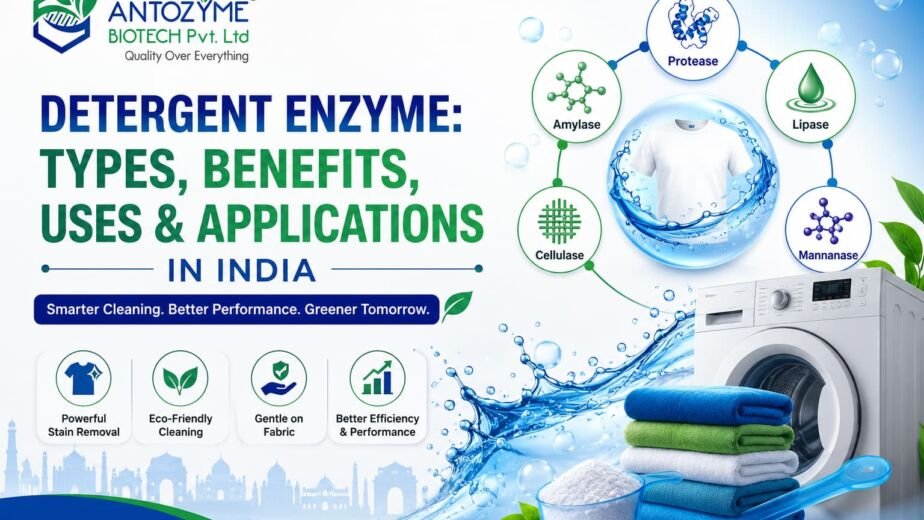
Enzymes used in detergent manufacturing play an important role in improving cleaning performance, especially against protein, starch, oil, and other organic stains. In India, detergent manufacturers increasingly use specialized enzyme solutions to develop effective laundry powders, liquids, gels, and other cleaning formulations.
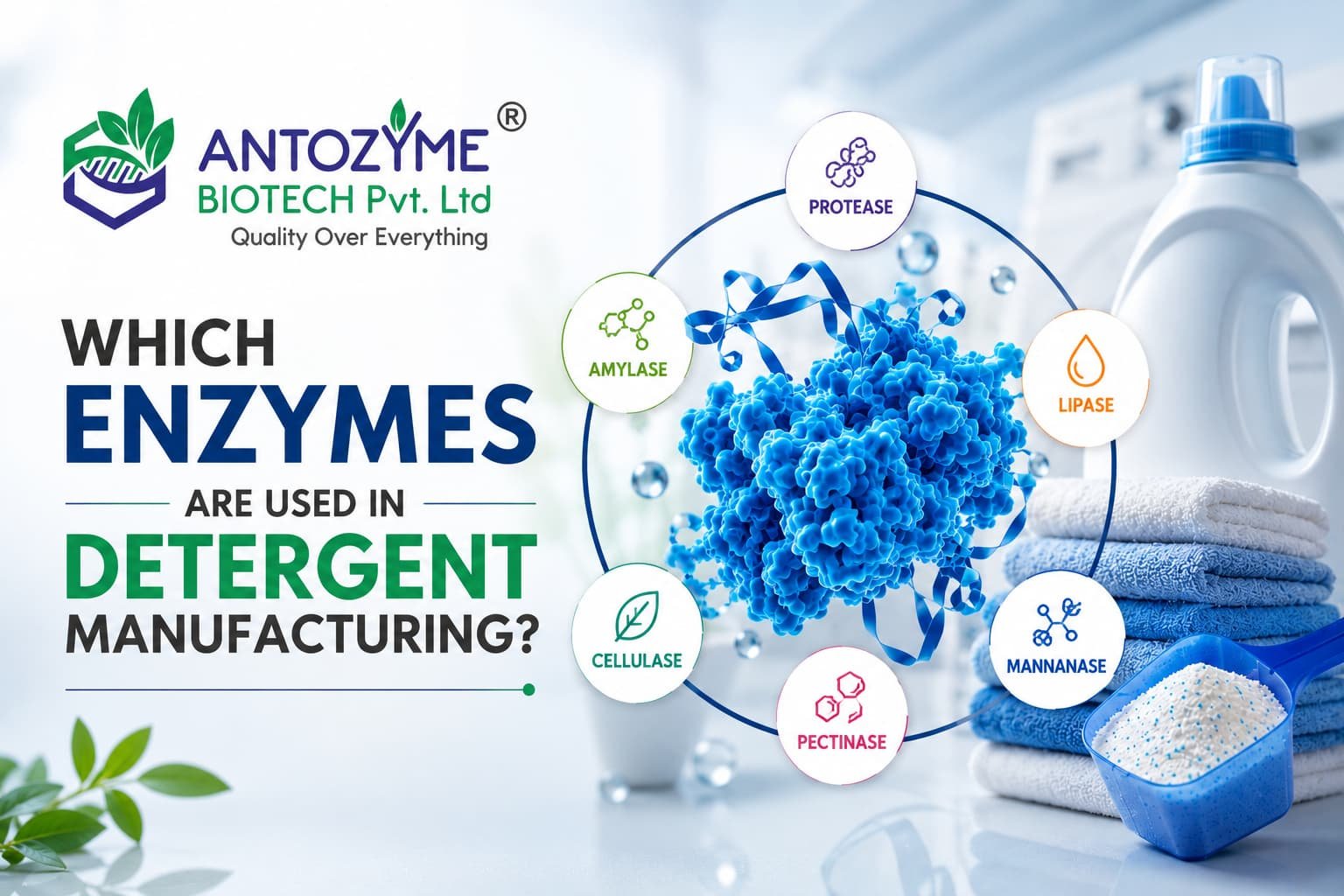
Different enzymes perform different functions. Protease, amylase, lipase, cellulase, pectinase, and mannanase are among the commonly used enzymes in detergent formulations, while customized multi-enzyme blends can be developed for specific cleaning requirements.
For detergent manufacturers and formulators in India, selecting the right enzyme depends on factors such as stain type, detergent format, pH, washing temperature, dosage, and overall formulation compatibility.
What Enzymes Are Used in Detergent Manufacturing?
Several types of enzymes can be incorporated into detergent formulations depending on the intended cleaning application. Each enzyme targets a particular type of soil or stain.
Commonly used detergent enzymes include:
- Protease – helps break down protein-based stains
- Amylase – helps remove starch-based soils
- Lipase – targets fats and oily stains
- Cellulase – supports fabric care and helps address cellulose-based soils
- Pectinase – assists in breaking down pectin-containing stains
- Mannanase – helps degrade mannan-based food and plant residues
- Multi-enzyme blends – combine different enzyme activities for broader cleaning performance
The appropriate enzyme system can vary significantly depending on the detergent formulation and its intended application.
Protease for Detergent Manufacturing
Protease is one of the most widely used enzymes in laundry detergent formulations. It works by breaking down proteins into smaller peptides and amino acids, making protein-based stains easier to remove during washing.
Protein stains can come from sources such as blood, sweat, food residues, egg, milk, meat, and other protein-containing soils.
Protease is therefore particularly useful in laundry detergents designed to handle everyday household stains.
For detergent manufacturers in India, selecting a protease with suitable activity, stability, and compatibility with the formulation is important for maintaining consistent cleaning performance.
Amylase for Detergents
Amylase is used to target starch-based stains. It breaks down starch molecules into smaller compounds that can be more easily removed during washing.
Common starch-containing stains include rice, potato, pasta, flour, sauces, gravy, and other food residues.
Because starch-based food stains are common in household laundry, amylase can be an important component of enzyme-based detergent formulations.
Amylase can also be combined with other detergent enzymes when a formulation needs broader stain-removal capabilities.
Lipase in Detergent Manufacturing
Lipase is used to help break down fats and oils. It hydrolyzes triglycerides into smaller components, making oily soils easier to remove from fabrics.
Lipase can be useful against stains caused by cooking oils, butter, grease, fat-containing foods, cosmetic residues, and body oils.
For laundry detergent manufacturers, lipase can provide an additional cleaning mechanism that complements protease and amylase.
Its effectiveness depends on formulation conditions, enzyme stability, washing temperature, and the type of oily soil being targeted.
Cellulase for Laundry Detergents
Cellulase works on cellulose fibers and has a somewhat different role from enzymes that primarily target food stains.
In laundry applications, cellulase can contribute to fabric-care performance by helping reduce loose fibers and maintaining the appearance of cotton fabrics. It can also assist in addressing certain cellulose-based soils.
Cellulase may therefore be incorporated into formulations where both cleaning performance and fabric-care properties are important.
The specific cellulase selected should be compatible with the intended textile application and detergent formulation.
Pectinase in Detergent Formulations
Pectinase breaks down pectin, a structural polysaccharide found in plant materials.
This makes pectinase potentially useful for formulations targeting stains containing plant-derived residues.
Pectin-containing soils can occur from foods such as fruits, vegetables, jams, sauces, and plant-based food residues.
Pectinase is generally considered a specialized detergent enzyme and may be used when the target application requires additional activity against particular plant-based soils.
Mannanase for Detergent Manufacturing
Mannanase breaks down mannan-type polysaccharides found in various plant-derived ingredients and food products.
Mannan-containing residues may be associated with ingredients such as sauces, ice cream, processed foods, and plant-based materials.
Mannanase can be incorporated into detergent formulations to complement other enzymes and broaden the range of organic stains that can be addressed.
Why Are Multiple Enzymes Used in Detergents?
A single enzyme generally targets a specific type of substrate. Real-world laundry, however, rarely contains only one type of stain.
For example, a single garment could contain food, oil, protein, and starch at the same time.
Using only one enzyme may therefore provide limited cleaning action against the complete stain profile.
A multi-enzyme formulation can provide complementary activities. Protease can target protein stains, amylase can address starch, lipase can work on oils and fats, while cellulase, pectinase, or mannanase can provide additional functionality depending on the formulation.
This is one reason detergent manufacturers may use customized enzyme blends rather than relying on a single enzyme.
What Is a Multi-Enzyme Blend for Detergents?
A multi-enzyme blend is a formulation containing two or more enzyme activities designed to work against different types of stains or provide complementary cleaning benefits.
For example, a detergent formulation may incorporate a combination of protease, amylase, lipase, and cellulase.
The exact combination depends on the detergent’s intended application.
A customized blend may be developed around factors such as:
- Target stain profile
- Detergent type
- pH
- Washing temperature
- Enzyme dosage
- Processing conditions
- Required cleaning performance
- Storage stability
- Compatibility with other ingredients
For detergent manufacturers seeking detergent enzymes in India, customized enzyme solutions can be particularly useful when standard enzyme products do not fully match the formulation requirements.
Which Enzyme Is Best for Detergent Manufacturing?
There is no single “best” enzyme for every detergent formulation.
The right enzyme depends primarily on what the detergent is expected to clean.
Protease is suitable when protein-based stains are a major concern. Amylase is useful for starch-containing food soils, while lipase can support the removal of oily and fatty residues.
When detergents need to address multiple types of stains, manufacturers may consider a combination of enzyme activities.
Therefore, enzyme selection should be based on the complete formulation and intended washing conditions rather than choosing an enzyme solely by its name or concentration.
How to Select Enzymes for Detergent Formulation
Selecting an enzyme for detergent manufacturing requires consideration of both the cleaning objective and the formulation environment.
Target Stains
Start by determining the primary stains the detergent needs to address.
For protein-rich stains, protease may be important. For starch-based food stains, amylase may be more relevant. If oily stains are a major concern, lipase may be required.
For mixed household stains, several enzyme activities may be beneficial.
Detergent Format
Enzymes can be incorporated into different detergent formats, including powder detergents, liquid detergents, laundry gels, concentrated detergents, and institutional or industrial cleaning formulations.
The enzyme system should be selected according to the physical and chemical characteristics of the final product.
pH Compatibility
Different enzymes have different activity and stability profiles.
The formulation’s pH should therefore be considered when selecting an enzyme. An enzyme that performs well under one set of conditions may not provide the same performance under another.
Washing Temperature
Washing temperatures can vary depending on the application.
An enzyme suitable for one temperature range may not be ideal for another. Manufacturers should therefore evaluate enzyme performance under the actual or expected washing conditions.
Compatibility With Other Ingredients
Detergents contain multiple ingredients that may influence enzyme performance.
The enzyme system should be evaluated for compatibility with surfactants, builders, chelating agents, bleaching systems, stabilizers, fragrances, and other functional ingredients.
This is particularly important when developing concentrated or highly specialized detergent products.
Enzyme Dosage in Detergent Manufacturing
Enzyme dosage should not be determined simply by adding a fixed quantity to every detergent formulation.
The required dosage can depend on enzyme activity, enzyme type, target stain, detergent composition, washing conditions, product concentration, desired cleaning performance, and stability during storage.
Manufacturers generally need to conduct formulation testing to identify an appropriate dosage for their specific product.
Using too little enzyme may result in insufficient cleaning performance, while unnecessarily high levels may increase formulation costs without providing proportional benefits.
Detergent Enzyme Manufacturing and Supply in India
India has a growing market for detergent and cleaning products, creating demand for reliable enzyme solutions for formulation and manufacturing applications.
A trusted detergent enzyme manufacturer in India can supply individual enzyme products as well as specialized enzyme combinations for different detergent applications.
Depending on the requirement, manufacturers and suppliers may provide protease, amylase, lipase, cellulase, pectinase, mannanase, and customized multi-enzyme blends.
For detergent manufacturers, working with an experienced enzyme manufacturer and supplier in India can make it easier to select enzyme products based on formulation requirements rather than purchasing a generic product without considering application conditions.
Technical support, product consistency, activity specifications, formulation compatibility, and application testing can also be important factors when selecting an enzyme supplier.
Applications of Detergent Enzymes in India
Detergent enzymes can be used across a range of cleaning applications in India.
Household Laundry Detergents
Enzymes can improve the ability of laundry products to address common food, protein, starch, and oily stains.
Liquid Detergents
Liquid formulations may require enzymes with suitable stability under their specific formulation conditions.
Detergent Powders
Enzymes are widely incorporated into powdered detergent systems, where appropriate enzyme stability and processing conditions need to be considered.
Institutional and Commercial Laundry
Hotels, hospitals, restaurants, laundries, and other commercial operations can have different soil profiles and washing requirements, making enzyme selection particularly important.
Industrial Cleaning
Specialized industrial cleaning formulations may use specific enzyme activities depending on the type of organic contamination involved.
Benefits of Using Enzymes in Detergent Formulations
The use of suitable enzymes can provide several formulation benefits:
- Improved removal of specific organic stains
- Better cleaning performance under suitable washing conditions
- Ability to target different types of soils
- Potential for more efficient detergent formulations
- Support for fabric-care properties with suitable enzymes
- Greater flexibility through customized enzyme combinations
However, the actual benefit depends on enzyme selection, formulation design, dosage, and application conditions.
Why Customized Detergent Enzyme Solutions Matter
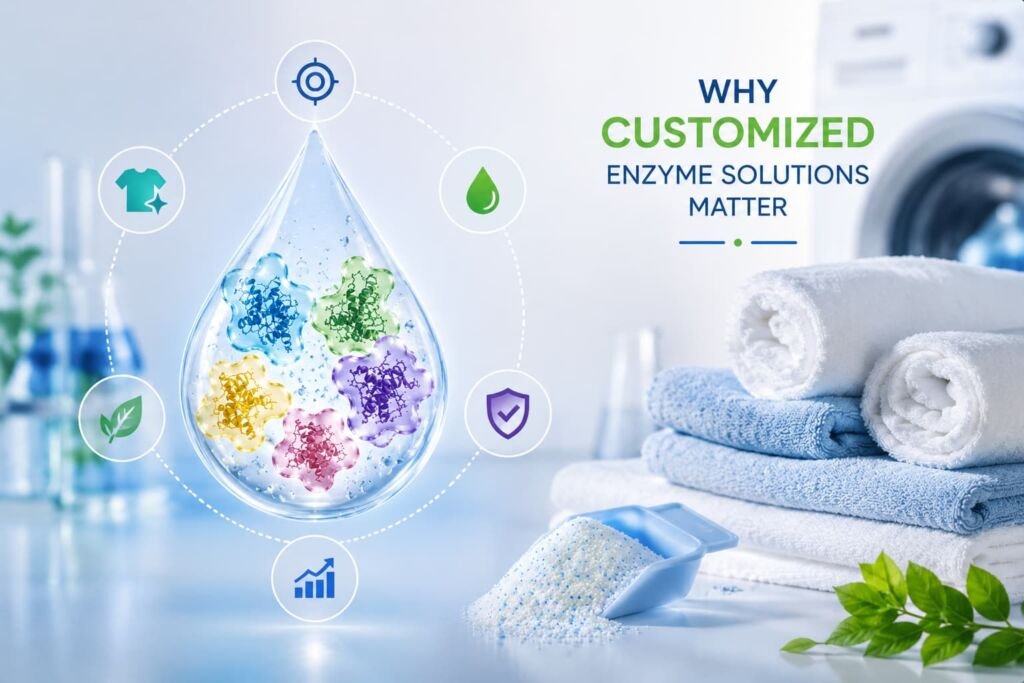
Every detergent formulation has different requirements. A general household laundry powder may have different enzyme requirements from a liquid detergent, commercial laundry product, or specialized industrial cleaner.
Customized enzyme solutions allow manufacturers to consider the specific characteristics of their product.
A customized enzyme blend can be developed by considering:
Target stains → Detergent format → pH → Temperature → Dosage → Washing conditions → Required performance
This approach can help detergent manufacturers select an enzyme system that is better aligned with their final product.
How to Choose a Detergent Enzyme Supplier in India
When sourcing enzymes for detergent manufacturing, manufacturers should evaluate more than just price.
Important factors include:
- Range of available enzyme types
- Product consistency
- Enzyme activity and specifications
- Application expertise
- Formulation support
- Customized enzyme blend capability
- Supply capacity
- Packaging and storage requirements
- Technical assistance
- Ability to meet specific manufacturing requirements
An experienced detergent enzyme supplier in India should be able to understand the application and recommend suitable enzyme solutions based on the manufacturer’s formulation objectives.
Conclusion
Enzymes used in detergent manufacturing serve different functions depending on the type of stain and cleaning requirement. Protease, amylase, lipase, cellulase, pectinase, and mannanase are among the key enzyme types used in detergent formulations.
Rather than selecting an enzyme based only on its general application, detergent manufacturers should consider factors such as stain profile, pH, temperature, detergent format, dosage, stability, and ingredient compatibility.
For manufacturers in India, sourcing from a reliable enzyme manufacturer and supplier can provide access to individual enzymes as well as customized multi-enzyme solutions designed around specific detergent formulations.
Frequently Asked Questions
Which enzyme is most commonly used in detergent?
Protease is one of the most commonly used detergent enzymes because it helps break down protein-based stains such as food residues, blood, sweat, and milk.
What are the main enzymes used in detergent manufacturing?
The main enzymes include protease, amylase, lipase, cellulase, pectinase, and mannanase. Multi-enzyme blends can also combine several activities for broader cleaning performance.
Why are enzymes added to laundry detergents?
Enzymes are added to laundry detergents to target specific organic stains. Different enzymes work on proteins, starches, fats, cellulose-related soils, and other organic residues.
Can multiple enzymes be used in one detergent?
Yes. Multiple enzymes can be combined into a multi-enzyme blend to address different types of stains within the same detergent formulation.
Which enzyme removes oil stains from clothes?
Lipase is used to target fats and oils. It can help break down oily soils into smaller components that are easier to remove during washing.
Which enzyme is used for protein stains?
Protease is used for protein-based stains. It breaks down proteins into smaller molecules, helping make these stains easier to remove.
How do I choose a detergent enzyme supplier in India?
Consider the supplier’s enzyme range, product consistency, technical expertise, customization capability, application support, supply capacity, and ability to meet your specific formulation requirements.
Can detergent enzyme blends be customized?
Yes. Multi-enzyme blends can be customized according to factors such as target stains, detergent format, pH, temperature, dosage, washing conditions, and desired cleaning performance.