Walk into any Indian supermarket and you will see the shift: concentrated liquids, “stain-removal” claims, and premium powders sitting beside traditional bars. Behind many of those claims is a small but powerful ingredient, the enzyme. For formulators and brand owners, understanding this market is the first step to finding the right detergent enzyme manufacturer in India.
This guide explains how large the opportunity is, what is driving demand, which enzymes matter most, and how to evaluate a supplier before you commit to a formulation.
What Is the Detergent Enzyme Market in India?
The detergent enzyme market in India covers the production, supply and use of enzymes that detergent brands add to powders, liquids, bars and pods to break down stains more effectively. These are biological catalysts, mostly hydrolases, that cut proteins, starches, fats and other soils into small, water-soluble pieces. If you are new to the topic, start with what detergent enzymes are before moving to formulation decisions.
Globally, laundry detergents are one of the largest application areas for industrial enzymes, and India is following the same path as washing habits modernise and brands compete on cleaning performance.
How Big Is the Indian Detergent Market? (And Why It Matters for Enzymes)
Most research firms publish figures for the detergent category rather than for detergent enzymes alone. Because enzyme demand follows detergent production, category growth is the most reliable guide. Published estimates differ by methodology, so treat them as a range:
| Source | Segment | Reported Size | Outlook |
|---|---|---|---|
| IMARC Group | India laundry detergent | USD 4.79 billion (2024) | USD 7.30 billion by 2033 (4.30% CAGR) |
| Ken Research | India laundry detergents | USD 5.0 billion (2025) | USD 6.64 billion by 2032 (4.13% CAGR) |
| MarkNtel Advisors | India liquid detergent | USD 1.12 billion (2025) | USD 1.57 billion by 2032 |
Whichever figure you use, the message is the same: steady mid-single-digit growth, a larger share moving toward branded and liquid formats, and more competition on performance, which is where enzymes earn their place.
What Is Driving Demand for Detergent Enzymes in India?
- Shift from bars and loose products to branded detergents. Urban and semi-urban households are moving toward formats that promise better stain removal.
- Growth of liquid detergents. Liquids need enzymes that stay stable in water-based systems and work well in machine and hand wash.
- Low-temperature washing. Enzymes allow effective cleaning at lower temperatures, which saves energy and protects fabrics.
- Sustainability and surfactant reduction. Novozymes has reported that multi-enzyme systems can replace up to 25% of a detergent’s surfactant system without hurting cleaning performance, which supports greener, more compact formulas.
- E-commerce, D2C and regional brands. New and regional players use “enzyme-powered” and “bio-based” positioning to stand out from established names.
Which Enzymes Are Most Used in Detergents?
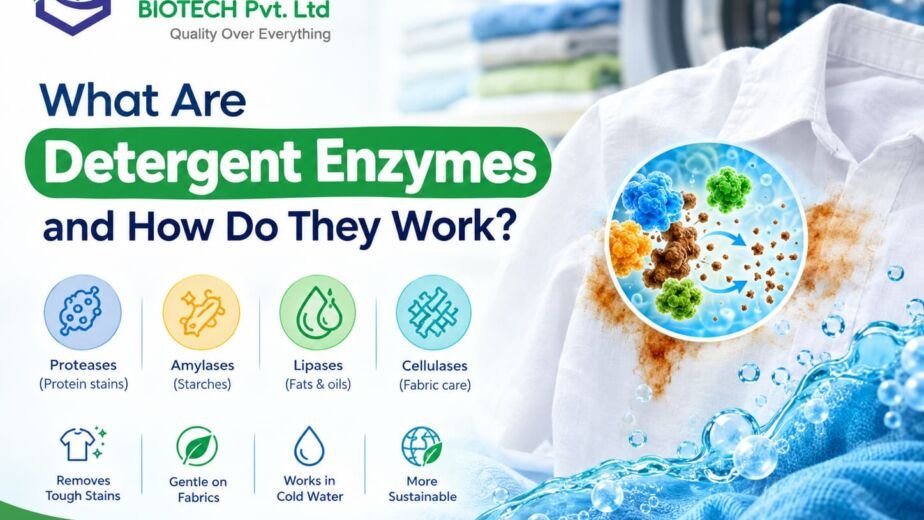
Different soils need different enzymes, which is why modern detergents often combine several. Here is a quick view; for deeper detail see our breakdown of the types of detergent enzymes and their benefits.
| Enzyme | What It Targets | Typical Benefit |
|---|---|---|
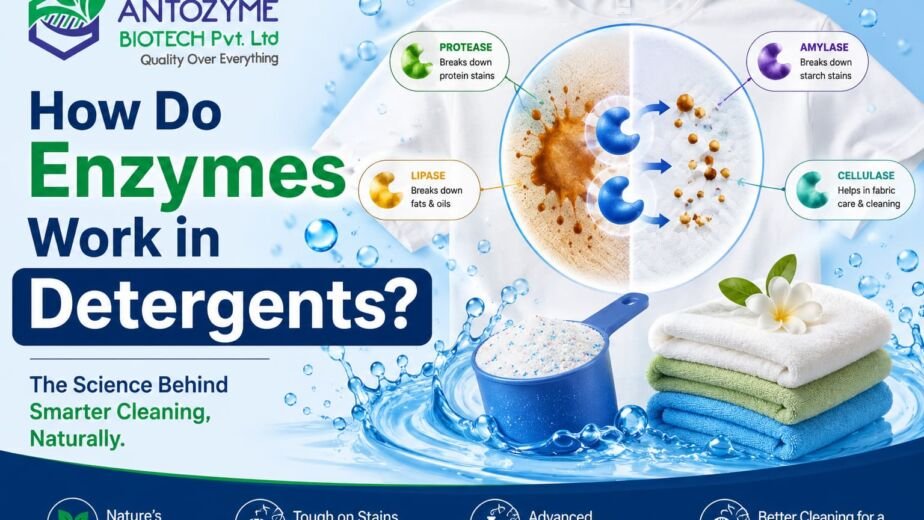
| Protease | Protein stains: blood, egg, milk, sweat, grass | The most widely used detergent enzyme; core of stain removal |
| Amylase | Starch stains: rice, gravy, potato, pasta, cereals | Cleans food residues, especially in kitchen-heavy loads |
| Lipase | Fats and oils: cooking oil, butter, body oils | Helps lift greasy, oily marks at lower temperatures |
| Cellulase | Microfibrils on cotton fibres | Improves colour brightness, softness and soil release |
| Mannanase | Gum-based soils: sauces, ice cream, cosmetics | Removes stubborn stains other enzymes miss |
To see how these fit into production, read about the enzymes used in detergent manufacturing, and for the science behind the action, see how enzymes break down stains at the molecular level.
Liquid vs Granule vs Powder: Which Enzyme Form Fits Your Product?
The enzyme form must match your detergent format. Choosing wrongly is one of the most common causes of activity loss on the shelf.
| Enzyme Form | Best For | Advantages | Watch-outs |
|---|---|---|---|
| Liquid enzymes | Liquid detergents, gels, dishwash liquids | Easy to dose and blend; no dust handling | Need stabilisers; sensitive to heat during storage |
| Granules (encapsulated) | Powder detergents, tablets | Protected from moisture and other ingredients; good shelf life | Compatibility with bleach and builders must be tested |
If you formulate powders, our guide to enzymes for detergent powder covers granule selection, dosage and storage in more detail.
Challenges Facing Indian Detergent Manufacturers
- Hard and variable water quality across regions affects enzyme performance.
- Heat and humidity during transport and storage can reduce enzyme activity.
- Price sensitivity, especially in mass-market and sachet categories, limits the enzyme dosage brands can afford.
- Ingredient compatibility, since surfactants, builders, bleach and preservatives can all inactivate enzymes.
- Supply consistency, including lead times, batch quality and technical support from distant suppliers.
Working with a nearby manufacturer who understands Indian conditions can shorten trials and reduce these risks.
How to Choose a Detergent Enzyme Manufacturer in India
A good supplier is a formulation partner, not just a vendor. Use this checklist when comparing options:
- Declared activity and assay method. Ask for activity units and how they are measured so you can compare like with like.
- Stability data. Request results across pH, temperature, surfactant systems and shelf life in a base similar to yours.
- Batch-to-batch consistency. A Certificate of Analysis with every lot should be standard.
- Range of forms and blends. Liquid, granule and multi-enzyme options let you adapt as your product line grows.
- Technical and formulation support. Look for help with dosage, compatibility trials and troubleshooting. Our guide on how to choose enzymes for laundry detergent formulation is a useful starting framework.
- Quality systems and documentation. Ask for relevant certifications, safety data sheets and handling guidance.
- Scale, lead time and logistics. Confirm minimum order quantity, production capacity and delivery reliability.
- Process transparency. A confident supplier can explain the detergent enzyme manufacturing process in India from fermentation to finished product.
Why Antozyme Biotech
Antozyme Biotech is an enzyme manufacturing and formulation company based in Vadodara, Gujarat, supplying liquid and granule detergent enzymes alongside enzymes for textile, food, starch, distillery, brewery, dairy and other industries. The company works with customers in India and export markets, supporting them from early concept through scale-up.
For detergent brands, that means enzyme grades matched to your format, application support during trials, and the flexibility to scale as your volumes grow.
Future Outlook: Where Is the Market Heading?
Expect continued growth in concentrated liquids, pods and eco-positioned products, all of which depend on stable, high-performing enzymes. Multi-enzyme systems, cold-wash performance and lower-surfactant formulas will keep enzymes central to product differentiation. Brands that build supplier relationships early will be better placed to launch faster and with fewer reformulations.
Conclusion
The detergent enzyme market in India is growing alongside the wider detergent industry, driven by liquids, low-temperature washing and the push for sustainable, high-performance products. The brands that win will be those that pair smart formulation with a dependable enzyme partner.
Looking for samples, technical data or a custom enzyme blend for your detergent range? Contact Antozyme Biotech to discuss your formulation and get started.
Frequently Asked Questions
What is the detergent enzyme market in India?
It is the market for enzymes such as protease, amylase, lipase, cellulase and mannanase that are added to detergents sold in India. Demand tracks the growth of the laundry detergent category and the shift toward higher-performance liquid and powder products.
How big is the detergent market in India?
IMARC Group valued the India laundry detergent market at USD 4.79 billion in 2024 and projects USD 7.30 billion by 2033. Other firms report slightly different figures, so estimates vary by methodology.
Which enzymes are most commonly used in detergents?
Protease is the most widely used because proteins are common in stains. Amylase, lipase, cellulase and mannanase are often added in blends to handle starch, grease, fabric care and gum-based soils.
Why are enzymes added to detergents?
Enzymes break stains into small, water-soluble pieces that wash away easily. They improve cleaning at lower temperatures and can reduce the amount of surfactant needed, supporting energy savings and more sustainable formulas.
Are liquid or granule detergent enzymes better?
Neither is universally better. Liquid enzymes suit liquid detergents and gels, while encapsulated granules suit powders and tablets. The right choice depends on your format, storage conditions and other ingredients.
How do I choose a detergent enzyme manufacturer in India?
Compare declared activity, stability data in your base, batch consistency, available forms, technical support, documentation and lead times. Ask for samples and run compatibility trials before committing to bulk orders.
Are enzyme detergents safe for skin and the environment?
Enzymes are biodegradable proteins and are used in small amounts in finished detergents. Manufacturers control exposure with encapsulation and handling practices. People with very sensitive skin should rinse well and follow product directions.
Can enzymes help detergents work in cold water?
Yes. Many detergent enzymes are active at low wash temperatures, which helps clean effectively while saving energy and being gentler on fabrics.