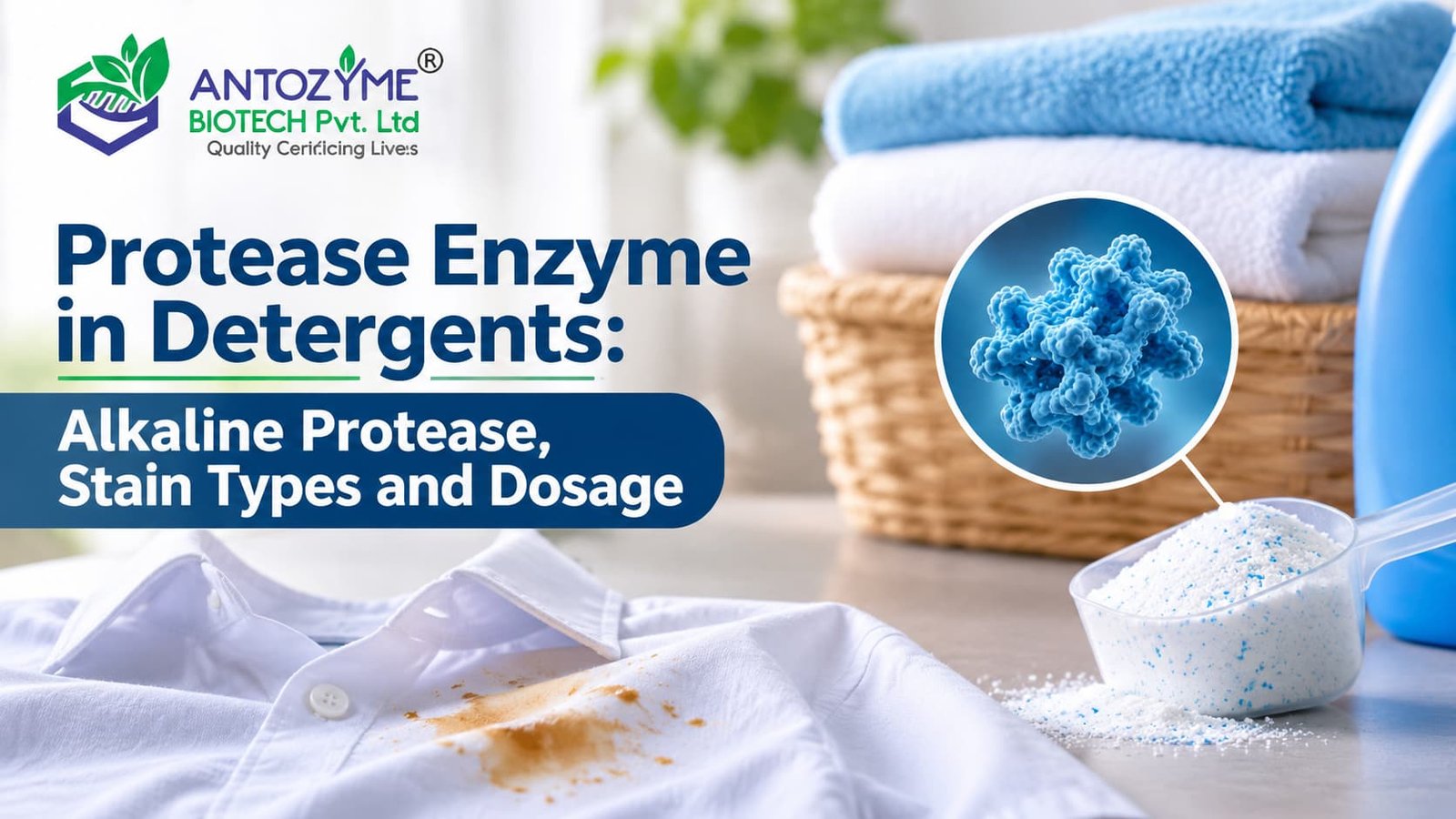
Blood, egg, milk, sweat and grass share one problem: they are proteins, and once they dry onto fabric, surfactants alone remove them poorly. Breaking them down is the job of protease, the most widely used enzyme in laundry detergents.
This guide explains how protease enzyme in detergents works, why alkaline protease is the standard choice, which stains it removes, how to set dosage, and how to choose between liquid and granular forms. It is written for formulators, R&D teams and brand owners. If you are new to the topic, start with what detergent enzymes are and how they work and our overview of the enzymes used in detergent manufacturing.
The short version
- Protease cuts proteins into small peptides and amino acids that rinse away in water.
- Detergents use alkaline protease because wash water is alkaline, so the enzyme must stay active there.
- Set dosage by activity, not by weight. Start from your supplier’s range and tune it with swatch tests.
- In liquids, protease can also digest other enzymes, so the stabilizer system matters as much as the dose.
What Protease Does in a Detergent
Protease is a hydrolase that cuts the peptide bonds holding proteins together. Protein stains such as blood, egg and milk dry into tough, insoluble deposits that cling to fibres. Protease splits them into smaller peptides and amino acids, which dissolve in the wash water. Surfactants then lift and carry those fragments away.
This is why protease sits at the core of most enzyme systems. It also helps with sweat and body soil on collars and cuffs, which contain protein alongside oils. For a wider view of how each enzyme fits, see how enzymes work in detergents and our guide to detergent enzyme types, benefits and uses.
Alkaline Protease: Why Detergents Use It
Laundry wash water is mildly to strongly alkaline, often somewhere in the pH 8 to 11 range depending on the detergent format. An enzyme that works best in acid or neutral conditions loses much of its activity there. Detergent proteases are therefore alkaline proteases, mostly subtilisin-type serine proteases from Bacillus strains, sometimes engineered for stronger performance in a wash.
Neutral and acid proteases have their own uses in food, leather and textile processing, but they are not the usual choice for a laundry or dishwash base.
Our Alkaline Protease Liquid is made for the detergent industry and targets protein stains such as grass, blood and egg. It is protein-engineered for stability and efficacy across different washing conditions, stays stable in alkaline pH and alongside surfactants, and can be used in liquid, powder and tablet detergents. For powders we also supply Protease Granules, a coated form that is less dusty, helps protect the enzyme from moisture and heat, and releases it steadily during the wash.
When you compare grades, check these points on the technical data sheet (TDS):
| Property | Why It Matters | What to Ask the Supplier |
|---|---|---|
| pH Range of Activity and Stability | Storage pH and wash pH are not the same. An enzyme must remain stable in the detergent during storage and perform effectively during washing. | Ask for activity data at your target wash pH and stability data at your finished product's storage pH. |
| Temperature Profile | Cold and warm washing conditions are common in India, making temperature-dependent enzyme performance important. | Request activity data at 20–30°C and at your typical washing temperature. |
| Surfactant Tolerance | Anionic surfactants can reduce enzyme activity, depending on the surfactant type and formulation conditions. | Ask for performance and stability data in a detergent base similar to your formulation. |
| Chelator and Builder Tolerance | Calcium loss can destabilize some enzyme systems and affect their performance in detergent formulations. | Check enzyme compatibility with citrate, phosphonates, EDTA, and other builders used in your formulation. |
| Oxidation Stability | Bleach and peroxide-based ingredients can damage enzyme active sites and reduce cleaning performance. | Ask whether the enzyme grade is suitable for bleach-containing detergent powders and request supporting stability data. |
| Water Hardness | Hard water changes washing conditions and can influence enzyme performance and stain removal. | Request test results under water hardness conditions representative of your target market. |
Stains Protease Removes (and Those It Does Not)
Protease works on stains that contain protein. Many everyday stains are mixed, so it is normally paired with other enzymes.
| Stain Group | Examples | What Protease Does |
|---|---|---|
| Blood and Body Fluids | Blood, sweat, saliva | Breaks down proteins that help bind stains to fabric fibres. |
| Dairy | Milk, curd, paneer, infant formula | Breaks down milk proteins such as casein, helping remove dairy-based stains. |
| Egg | Egg yolk and egg white | Breaks down cooked and dried egg proteins that can cling to fabric. |
| Meat and Gravies | Meat juices, fish, protein-rich gravies | Removes the protein component of the stain, while lipase targets the fat component. |
| Grass and Soil | Grass stains, mud containing organic matter | Helps break down protein-containing organic residues present in complex stains. |
| Mixed Food Stains | Dal, curry, sauces, chocolate | Targets the protein component and works alongside amylase and lipase to address starch and fat residues. |
Protease does not remove everything. Oil and grease need lipase and surfactants, starch needs amylase, and pigment stains such as turmeric, ink and tea depend mainly on surfactants and bleach.
One caution for your label: wool and silk are protein fibres, so protease can damage them. Enzyme detergents are normally not recommended for these fabrics.
Protease Dosage in Detergents: How to Set It
Dose protease by activity, not by weight. Two grades with the same weight can differ several times in activity, so a fixed percentage copied from another formula can leave you under-dosed or overpaying. Start from the activity figure and assay method printed on the technical data sheet (TDS), then tune the dose for your own conditions. A grade with twice the activity needs about half the weight to do the same job.
In practice, enzyme products are dosed at a small fraction of the finished detergent, and protease is often the largest part of the enzyme package. The exact figure depends on the grade, so take the starting range from the TDS and then tune it:
- Start at the supplier’s recommended dose. Include the other enzymes in your blend.
- Run a dose-response test. Wash soiled swatches below, at and above the recommended dose.
- Find where the gain flattens. Past that point, extra enzyme adds cost but little cleaning.
- Add an overage for shelf life if activity will fall before the product is used, as in a liquid. Decide the figure from stability data on your own base.
Factors that move the right dose up or down:
- Wash temperature and contact time, especially in hand wash and short machine cycles
- Water hardness and wash pH
- Surfactant system and other ingredients in the base
- Expected stain load and your price tier (economy, mid-range or premium)
Compare grades on cost-in-use (cost per wash at the dose that performs), not price per kg. Our guide on choosing enzymes for a laundry detergent formulation walks through the wider selection process.
Not sure where to start? Share your detergent format, wash pH and target wash temperature with us, and we will suggest a starting protease grade and dose for your trials.
Liquid vs Granular Protease
The protease form must match your detergent format. Choosing wrongly is a common cause of activity loss on the shelf.
| Form | Best For | Strengths | Watch-outs |
|---|---|---|---|
| Liquid Protease | Liquid detergents, gels, dishwashing liquids | Easy to dose and blend into formulations, with no dust generation during handling. | Requires a suitable stabilizer system. Sensitive to heat during storage and may digest other enzymes in the same formulation. |
| Granular Protease | Powder detergents, tablets | Coated and protected against moisture, offers good shelf life and helps minimize dust during handling. | Check compatibility with bleach systems, builders and moisture levels in the finished powder formulation. |
In liquids, protease is both the workhorse and the main risk. It can digest itself and any amylase, lipase or cellulase in the same bottle. Formulators usually combine lower water activity (polyols), calcium where the enzyme needs it, and a reversible protease inhibitor. Rules on boron-based inhibitors differ by market, so check where you sell. Our liquid detergent enzyme stability guide covers stabilization, compatibility and shelf-life testing in detail.
In powders, the coating does the protecting. Our guide to enzymes for detergent powder covers granule selection, dosage and storage. Enzyme dust can cause respiratory sensitization, so follow the safety data sheet (SDS) for handling in your plant.
For dishwash products, test protease separately in your own base, because surfactants, alkalinity and soil load differ from laundry. See our dishwashing enzymes page.
Protease in Multi-Enzyme Blends
Real stains mix protein with starch, fat and cotton fuzz, so protease rarely works alone. A common setup is protease, amylase and lipase for a standard detergent, with cellulase added for fabric care in a premium product.
| Partner Enzyme | Main Target | How It Works with Protease |
|---|---|---|
| Amylase | Starch: rice, gravy, potato | Breaks down starch residues that can trap protein in complex food stains, supporting protease in overall stain removal. |
| Lipase | Fats and oils | Targets the fat component of mixed stains. In liquid detergent formulations, it needs suitable protection against protease degradation. |
| Cellulase | Cotton microfibrils | Helps improve fabric colour appearance, softness and soil release by acting on surface fibres. |
Antozyme supplies individual enzymes and ready multi-enzyme blends, including 4-in-1 and 6-in-1 options in liquid and granule form. See the full range on our detergent enzymes page.
Testing and Troubleshooting Protease Performance
Test on your final formula, including fragrance, preservative and packaging, because a simplified base can hide problems. Wash standardized soiled swatches (for example blood, milk and ink on cotton) against a fresh reference, at your real wash temperature and water hardness. Measure residual enzyme activity with the same assay method each time, and link it to cleaning results, since activity and stain removal do not always move together.
| Symptom | Likely Cause | What to Try |
|---|---|---|
| Weak Removal of Protein Stains | Dose too low, wash pH or temperature outside the enzyme's effective range, or activity lost during storage. | Check the technical data sheet (TDS) against actual washing conditions and run a dose-response test. |
| Good in Week One, Weaker by Month Six | Autolysis, heat exposure, or insufficient stabilizer in a liquid formulation. | Review stabilizer and inhibitor levels. Monitor enzyme activity under accelerated storage conditions at 25°C and 37–40°C. |
| Amylase or Lipase Loses Activity Before Protease | Protease degrading the other enzymes in the formulation. | Reassess protease dosage and inhibition strategy. Refer to the liquid detergent enzyme stability guide. |
| Strong in the Lab, Poor After Warehouse Storage | Actual storage temperatures are higher than the conditions used during stability testing. | Test at temperatures representative of warehouse conditions and improve packaging and storage practices. |
| Haze or Sediment in a Liquid | Possible calcium interactions with anionic surfactants or other formulation ingredients. | Review added calcium levels, ingredient compatibility, and the order of ingredient addition. |
Treat accelerated stability tests as a guide only. Real-time data confirms the shelf life you print on the label.
Choosing a Protease Supplier in India
A good supplier helps you solve formulation problems, not just quote a price. Ask any supplier, including us, for these in writing:
- Declared activity and the assay method used
- pH and temperature profile, including cold-wash temperatures
- Stability data in a base similar to yours
- A certificate of analysis (COA) with every batch
- Liquid and granule forms, and the option of a custom blend
- Dosage range, storage conditions, shelf life and the SDS
- Technical help during trials, plus realistic lead times and minimum order quantity
Our detergent enzyme market guide has a fuller supplier checklist.
How Antozyme Can Help
As a detergent enzymes manufacturer in India, we manufacture and supply individual enzymes and customized multi-enzyme blends for laundry and dishwash formulations, for customers in India and export markets. Our application laboratory supports comparative benchmarking, enzyme activity analysis, fabric swatch testing and controlled washing evaluations, so dosage decisions rest on measured results. Read more about the protease range or about the company.
Looking for bulk supply? See our pages for enzymes for laundry detergent manufacturers in India and detergent enzyme exports.
Developing an enzyme detergent? Contact our technical team with your base type, wash pH, target wash temperature and stain priorities. We will suggest a starting protease grade and arrange samples for your trials.
Frequently Asked Questions
What does protease do in a detergent?
Protease breaks protein stains such as blood, egg, milk and sweat into small peptides and amino acids that wash away in water.
Why is alkaline protease used in detergents?
Wash water is alkaline, and alkaline protease stays active at those pH levels, where neutral or acid proteases would lose activity.
How much protease should I add to a detergent?
It depends on the grade’s activity, your format and wash conditions. Calculate the dose from target activity, start from the supplier’s TDS range and tune it with a dose-response swatch test.
Can protease be used in liquid detergents?
Yes, with a stabilizer system. Protease can digest other enzymes in the bottle, so liquids usually need controlled water activity, calcium where required and a reversible protease inhibitor.
Is liquid or granular protease better?
Neither is better in general. Use liquid protease for liquid detergents and gels, and coated granules for powders and tablets.
Does protease work in cold water?
Many detergent proteases stay active at low wash temperatures, but it varies by grade. Check the temperature profile on the TDS and test at your real wash temperature.
Can protease damage fabrics?
It is safe on cotton and most synthetics at correct dosage. It can damage wool and silk because they are protein fibres.
Can I use protease together with lipase and amylase?
Yes, most detergents combine them. In liquids, the formula must protect lipase and amylase from the protease.